Central Coast Tree Services — tree removal and tree services Call 0485 835 759

Looking After Trees Close to the Water

A tree two streets back from the beach lives a completely different life to the same species at Ourimbah. Salt, wind and sand are the three things this page covers.

  • No obligation
  • Fixed quote after an on-site look
  • All Central Coast suburbs

Talk it through

No obligation. Takes 30 seconds.

No obligation. We ring you back to talk through the tree and arrange a time to look at it.

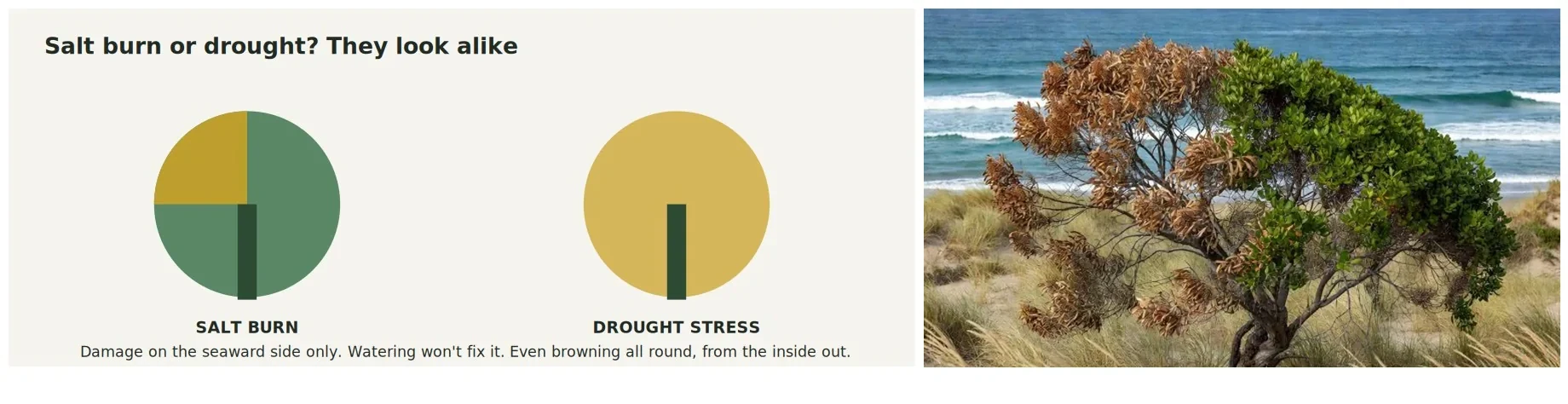
Diagram comparing salt burn on the seaward side with even drought browning, beside a photographic interpretation of a salt-burnt coastal tree.
Salt burn hits the seaward side only.

Central Coast Tree Services does coastal tree care and related tree work for homes and businesses across the Central Coast. Send us the suburb and what the tree is doing; the quote follows an on-site look, with no obligation.

Salt burn looks like drought and isn't

Browning and crisping from the seaward side, worst after a big blow, and it recovers on the sheltered side first. Watering won't fix it — the damage is deposition on the foliage, not lack of moisture at the root. Rinsing foliage with fresh water after a serious salt-laden easterly genuinely helps young plantings.

Why beachfront canopies grow lopsided

Persistent onshore wind kills growing tips on the exposed side, so the canopy develops away from the water. That flagged shape is normal and usually not a defect. It does mean pruning needs care: removing weight from the sheltered side of an already asymmetric tree can make it less stable rather than more.

Sandy soil and anchorage

Sand drains fast and holds a root plate poorly once saturated. That combination — days of rain then sustained wind — is what puts whole trees over on the Peninsula and around the lakes. If the ground on one side of a big tree has heaved or cracked, treat it as urgent even if the tree looks fine.

What actually thrives near the water here

Coastal banksia, tuckeroo, port jackson fig, cabbage tree palm and NSW christmas bush all handle exposure well. Norfolk Island pines are iconic along this coast and cope with salt admirably, but they get very large and, like any tree here, are protected unless the work fits an exemption — worth knowing before you plant one three metres from the house.

Indicative pricing

Where this job typically sits. Access is usually a bigger cost driver than size.

JobIndicative priceWhat moves it
Tree trimming / pruning$300 – $900Clearance off a roof, deadwooding or a crown reduction. Central Coast price guides published in July 2026 put the average near $425.
Palm removal$250 – $1,200Cocos and bangalow palms — no real wood, so cheap unless the crown must come out in pieces.

These rows come from the full price guide. The ranges were compiled on 31 July 2026 from published Central Coast and NSW tree-work price guides and are not yet checked against local quotes. Every tree is different, so you get a fixed written quote after an on-site assessment. All eight ranges are on the price guide.

Coastal Tree Care — common questions

Does salt air affect trees here?

Yes, and it shows as leaf burn and dieback on the seaward side, thinner canopies and shorter useful life for species that are not adapted to it. Trees closer to the water and on exposed headlands take it hardest.

Which trees actually cope near the coast?

Locally native species that evolved in the conditions generally do best. Ask us what is establishing well in your specific street rather than trusting a general planting list — exposure changes street by street here.

Do coastal trees need different pruning?

The Standard is the same, but exposed trees are less able to absorb heavy reduction, so conservative pruning matters more. Cutting a wind-exposed tree hard often triggers weak regrowth that the next big southerly finds.

Other tree services on the Central Coast

Talk to a Central Coast arborist

Tell us the suburb and what the tree needs — we will arrange a time to look at it.

Call 0485 835 759